HULL UK
HULL
HomeImprovementEstabilización con cal y cemento

Lime and Cement Stabilization in Hull – Geotechnical Treatment for Soft Estuarine Soils

Geotechnical engineering with regional judgment.

LEARN MORE

Hull grew rapidly during the 19th century on the flat alluvial plain of the Humber Estuary. The city's subsoil consists mainly of soft alluvial clays and silts with high moisture content, often reaching depths of 15 m before reaching competent glacial till. These conditions have always posed a challenge for urban development. Treating the ground with lime or cement is the most cost-effective way to transform these weak deposits into a workable construction platform. Before applying the binder, we always run a full suite of laboratory tests — particularly through a clasificación de suelos to determine plasticity index and organic content, which directly influence the required dosage. For Hull's marine clays, quicklime is usually preferred over cement when the natural moisture content exceeds 40%.
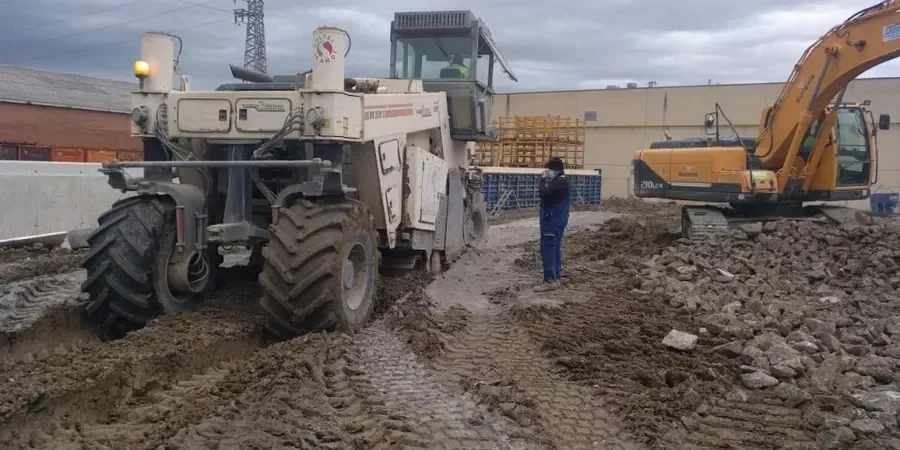
Illustrative image of Lime and cement stabilization in Hull
In Hull's soft alluvial clays, lime pre-treatment followed by cement injection can raise shear strength from 20 kPa to over 150 kPa within 14 days.

Our service areas

Scope of work

Our field crew mobilises a volumetric mixer and pneumatic spreader to apply lime or cement at rates between 2% and 8% by dry mass of soil. We work with a single-shaft rotary mixer capable of reaching depths up to 4 m in a single pass. The sequence is straightforward: spread the binder, mix to a uniform colour, compact with a vibratory roller, and cure for 7 to 14 days. For road subgrades in Hull we combine lime pre-treatment with a ensayo CBR at 96 hours to verify stiffness gain before placing pavement layers. Laboratory control includes Atterberg limits, compaction curves, and unconfined compressive strength at 7 and 28 days. The treated material typically achieves a CBR value above 15%, which is sufficient for light industrial pavements and access roads in the city's docklands.
Technical reference — Hull

Area-specific notes

In Hull, the contrast between the central old town area and the western suburbs near the Humber Bridge reveals very different soil profiles. The old town sits on firmer alluvial terrace deposits with occasional sand lenses. The western suburbs, closer to the estuary, have up to 8 m of very soft silty clay with organic layers. The main risk of lime and cement stabilization in those soft zones is incomplete mixing due to high water content — if the binder is not properly dispersed, untreated pockets remain and cause differential settlement. We mitigate this by adjusting mixer speed and conducting trial panels before full production. The risk of delayed swelling in sulphate-bearing clays also requires careful chemical testing prior to treatment.

Need a geotechnical assessment?

Reply within 24h.

Email: contact@geotechnical-engineering.biz

Standards used


BS EN 16907-2:2018 (Earthworks – Part 2: Classification of materials), BS 1377-9:1990 (Methods for test of soils for civil engineering purposes – Part 9: In-situ tests), Eurocode 7 – EN 1997-2:2007 (Ground investigation and testing), TRL Report 433 (Lime stabilisation for road construction)

Technical parameters

ParameterTypical value
Binder typeQuicklime (CaO) or Portland cement CEM I 42.5N
Dosage range2% – 8% by dry mass of soil
Mixing depthUp to 4 m per pass (single shaft rotary mixer)
Target CBR after treatment> 15% (verified per BS 1377-4)
Unconfined compressive strength (28 d)0.5 – 2.5 MPa depending on clay type
Curing period before loading7 – 14 days (ambient temperature dependent)

Common questions


What is the difference between lime stabilization and cement stabilization for Hull's soft clays?

Lime (quicklime) is preferred when the natural moisture content exceeds 40% because it first dries the soil through hydration before initiating pozzolanic reactions. Cement works faster and produces higher early strength, but in Hull's alluvial clays with high plasticity, cement can cause excessive shrinkage cracking if the dosage exceeds 6%. For most projects in the city, we recommend a combined approach: lime pre-treatment followed by cement injection.

How much does lime and cement stabilization cost in Hull?

The typical cost range for lime and cement stabilization in Hull is between £620 and £1,700 per project, depending on the treatment area, depth, binder type, and required strength. A small trial panel for a housing development might be at the lower end, while full-depth treatment of a 500 m² industrial slab falls at the upper end. We always provide a fixed-price quote after reviewing the ground conditions and target performance criteria.

How long does the stabilization take before construction can continue?

After mixing and compaction, the treated layer needs a curing period of 7 to 14 days before it can be loaded. In Hull's cool, damp climate, we recommend 14 days for lime-treated soils to reach 80% of design strength. Cement-treated soils can be loaded after 7 days if ambient temperatures stay above 10°C. We verify readiness with a field CBR test before allowing traffic or formwork.

Do I need a ground investigation before lime or cement stabilization in Hull?

Yes, absolutely. We need to know the natural moisture content, plasticity index, organic content, and sulphate concentration of the in-situ soil before designing the treatment. A standard investigation includes boreholes or trial pits, laboratory classification tests, and a chemical analysis. Without this data, the stabilization may fail due to underdosing, overdosing, or adverse chemical reactions. We recommend a minimum of one trial pit per 500 m² in Hull's variable alluvial soils.

Location and service area

We serve projects across Hull.

Location and service area