HULL UK
HULL
HomeLaboratoryClasificación de suelos USCS/AASHTO

Soil Classification (USCS/AASHTO) in Hull

Geotechnical engineering with regional judgment.

LEARN MORE

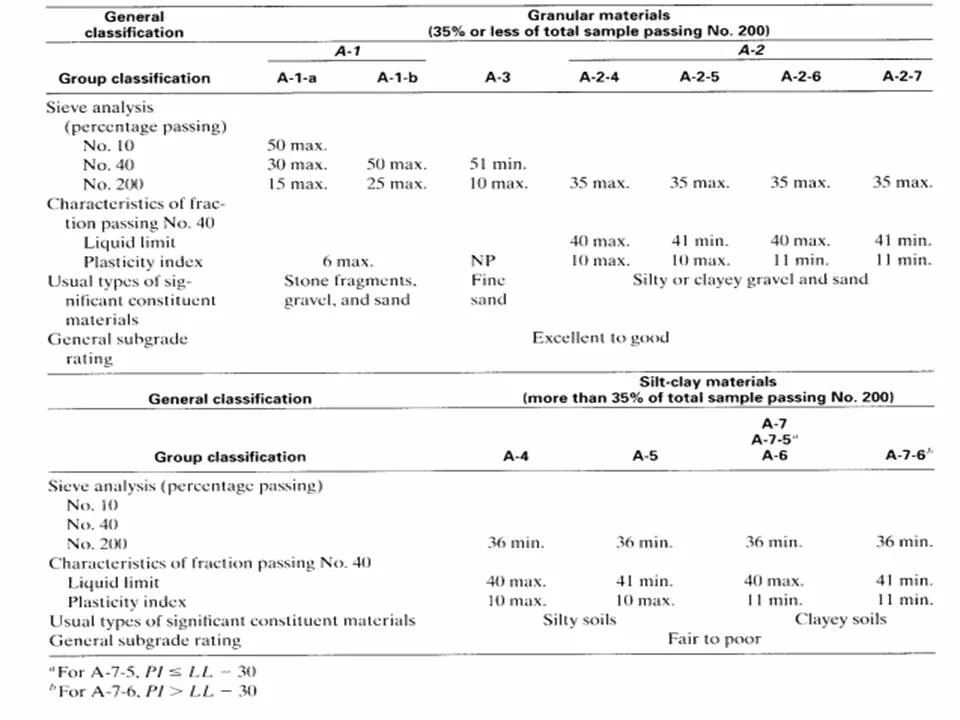
The geology beneath Hull is dominated by glacial till and alluvial deposits from the Humber Estuary. These soils often contain soft clays, silts, and peat layers with high compressibility. A proper soil classification using USCS and AASHTO standards is critical here. Without it, foundation designs may underestimate settlement. The team applies BS 5930 and Eurocode 7 to classify samples accurately. This data feeds directly into bearing capacity analysis and settlement predictions. Before any structural design, an ensayo SPT provides the N-values needed to correlate classification with strength. Hull's variable ground demands this level of rigor from the start.
Illustrative image of Soil classification (USCS/AASHTO) in Hull
In Hull's glacial till, misclassification by one USCS group can change bearing capacity estimates by 50% or more.

Our service areas

Scope of work

A common mistake contractors make in Hull is assuming all glacial till behaves the same. That assumption fails. The till here varies from dense sandy gravel to soft cohesive clay within meters. Soil classification identifies these changes. The lab uses sieve analysis (BS 1377-2) and Atterberg limits (BS 1377-2) to determine USCS group symbols and AASHTO group indices. For fine-grained fractions, the Casagrande plasticity chart separates low-plasticity clays (CL) from high-plasticity ones (CH). A granulometria test is run on every sample to confirm the particle size distribution. This avoids misclassification that could lead to overestimated bearing capacity or excessive differential settlement.
Technical reference — Hull

Area-specific notes

Hull's urban expansion since the 19th century has pushed development onto low-lying estuarine floodplains. Many Victorian foundations sit on unclassified fill or soft alluvium. Today, new builds in areas like Kingswood and Bransholme encounter peat lenses and compressible silts. Without a USCS or AASHTO classification, engineers lack the baseline data to assess settlement potential or liquefaction risk. A single misclassified CL layer in a CH profile can trigger differential cracking in load-bearing walls. The cost of reclassification after slab pour is far higher than doing it right at the investigation stage.

Need a geotechnical assessment?

Reply within 24h.

Email: contact@geotechnical-engineering.biz

Standards used


BS 5930:2015 (Code of practice for ground investigations), BS EN ISO 14688-2 (Standard Practice for Classification of Soils for Engineering Purposes - USCS), AASHTO M145-91 (Standard Specification for Classification of Soils - AASHTO), Eurocode 7 (EN 1997-1:2004, Section 3 - Geotechnical Design)

Technical parameters

ParameterTypical value
USCS Group SymbolCL, CH, ML, SM, GC
AASHTO Group Index0 to 20+ (A-1 to A-7-6)
Liquid Limit (LL)20% - 80% (per BS 1377-2)
Plasticity Index (PI)5% - 45% (CL vs CH boundary at 35%)
Percent Passing No. 200 Sieve10% - 90% (silt/clay vs sand/gravel)
Natural Moisture Content15% - 55% (soft ground zones near estuary)

Common questions


What is the difference between USCS and AASHTO soil classification?

USCS (BS EN ISO 14688-2) groups soils by particle size and plasticity — coarse-grained (G, S) vs fine-grained (M, C, O) with dual symbols for borderline cases. AASHTO (M145-91) focuses on pavement performance, ranking soils from A-1 (best) to A-7-6 (poor) using a group index that weights fines content and plasticity. Both are standard in Hull but serve different design needs.

How much does a soil classification test in Hull cost?

The typical range for a full USCS or AASHTO classification including sieve, hydrometer, and Atterberg limits is between £50 and £90 per sample. Volume discounts apply for projects with 10+ samples. The final quote depends on sample preparation time, number of sieve fractions, and whether hydrometer analysis is needed for the silt-clay fraction.

Why is soil classification important for Hull's glacial till?

Hull's glacial till is heterogeneous — it can grade from dense gravelly sand to soft clay in a single borehole. Classification identifies the dominant USCS group, which directly controls allowable bearing capacity, settlement estimates, and excavation stability. Misclassification can lead to over-designed foundations or, worse, differential settlement in residential slabs.

Which ASTM standards do you follow for classification?

We use BS EN ISO 14688-2 for USCS group assignment, BS 1377-2 for Atterberg limits, and BS 1377-2 for sieve analysis. For the fine fraction passing No. 200 sieve, we apply BS 1377 (hydrometer). All methods are run under ISO 17025 accreditation. BS 5930:2015 is also used for sample description and logging.

Can you classify soils with high organic content (peat) in Hull?

Yes. Peat and organic soils are classified as PT (peat) under USCS when organic content exceeds 25%. In Hull's alluvial zones near the Humber, we first run loss on ignition (LOI) per BS 1377-3 to measure organic content. If LOI exceeds 20%, the sample is classified as OL or OH depending on plasticity, or as PT for fibrous peat. These soils require special foundation treatment like Improvement or piling.

Location and service area

We serve projects across Hull.

Location and service area